For Willow, progress meant being able to walk into the rehabilitation centre instead of being carried.
Following cervical spinal surgery, this 13-year-old dog needed considerable help to move her hindlimbs during underwater treadmill sessions. By her sixth session, she was advancing both hindlimbs independently.
Steven Graham, from The Suddy Dog Rehabilitation Centre in Northern Ireland, shares how physiotherapy, hydrotherapy and Tendiboots™ gait analysis helped his team support Willow’s recovery and identify the difficulties that still required attention.
Cervical disc extrusion: why recovery involves more than walking
An intervertebral disc extrusion occurs when material from a disc moves into the spinal canal, potentially compressing and injuring the spinal cord. Depending on the location and severity, affected dogs may experience pain, weakness and impaired coordination.
Surgery aims to relieve compression, while postoperative rehabilitation supports the recovery of movement and function. Some dogs regain the ability to walk while continuing to show weakness or an unsteady gait. Source: American College of Veterinary Surgeons.
For rehabilitation professionals, the challenge is therefore to assess both independence and movement quality: how the dog advances each limb, places its paws and manages everyday activities.
Meet Willow: a complex postoperative presentation
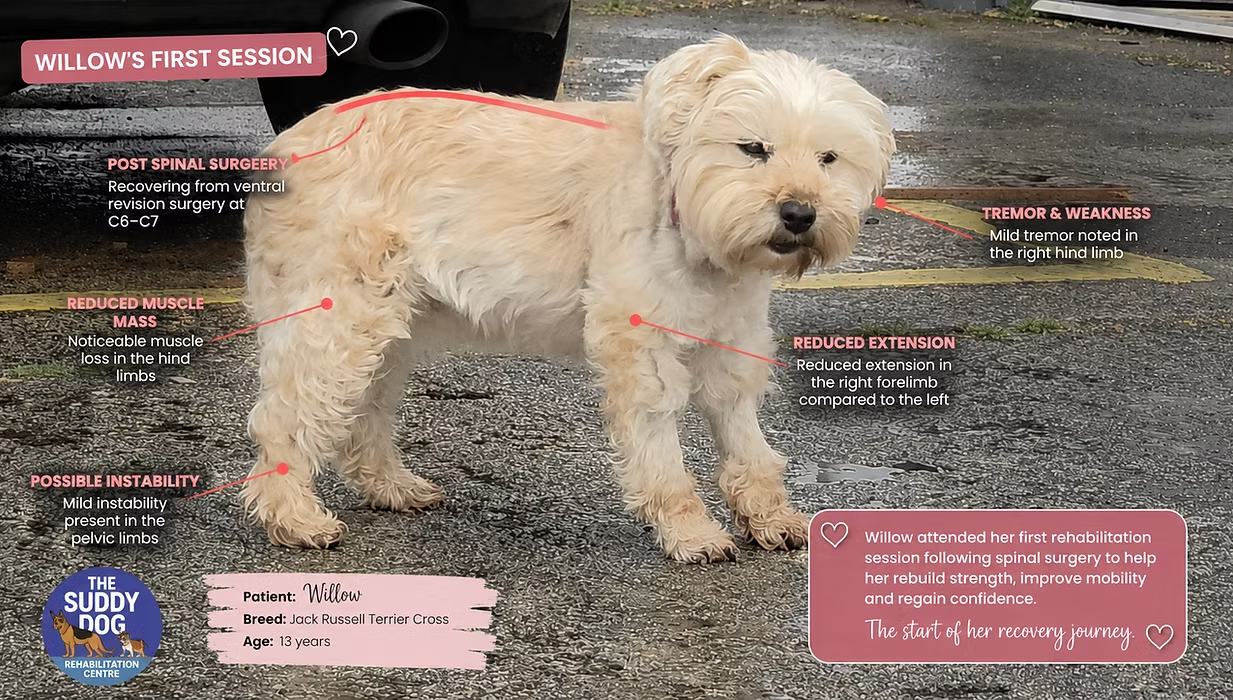
Willow is a 13-year-old spayed female Jack Russell Terrier cross Shih Tzu, weighing 7.3 kg.
She was referred by Dr Bronach McClean at Veterinary Specialists Ireland following surgery for a C6–C7 cervical disc extrusion. Her history included an initial ventral slot decompression, followed by neck pain and weakness affecting all four limbs, known as tetraparesis. Revision surgery was subsequently performed.
At the specialist recheck, Willow could walk independently but remained moderately uncoordinated, with mild cervical discomfort and stiffness.
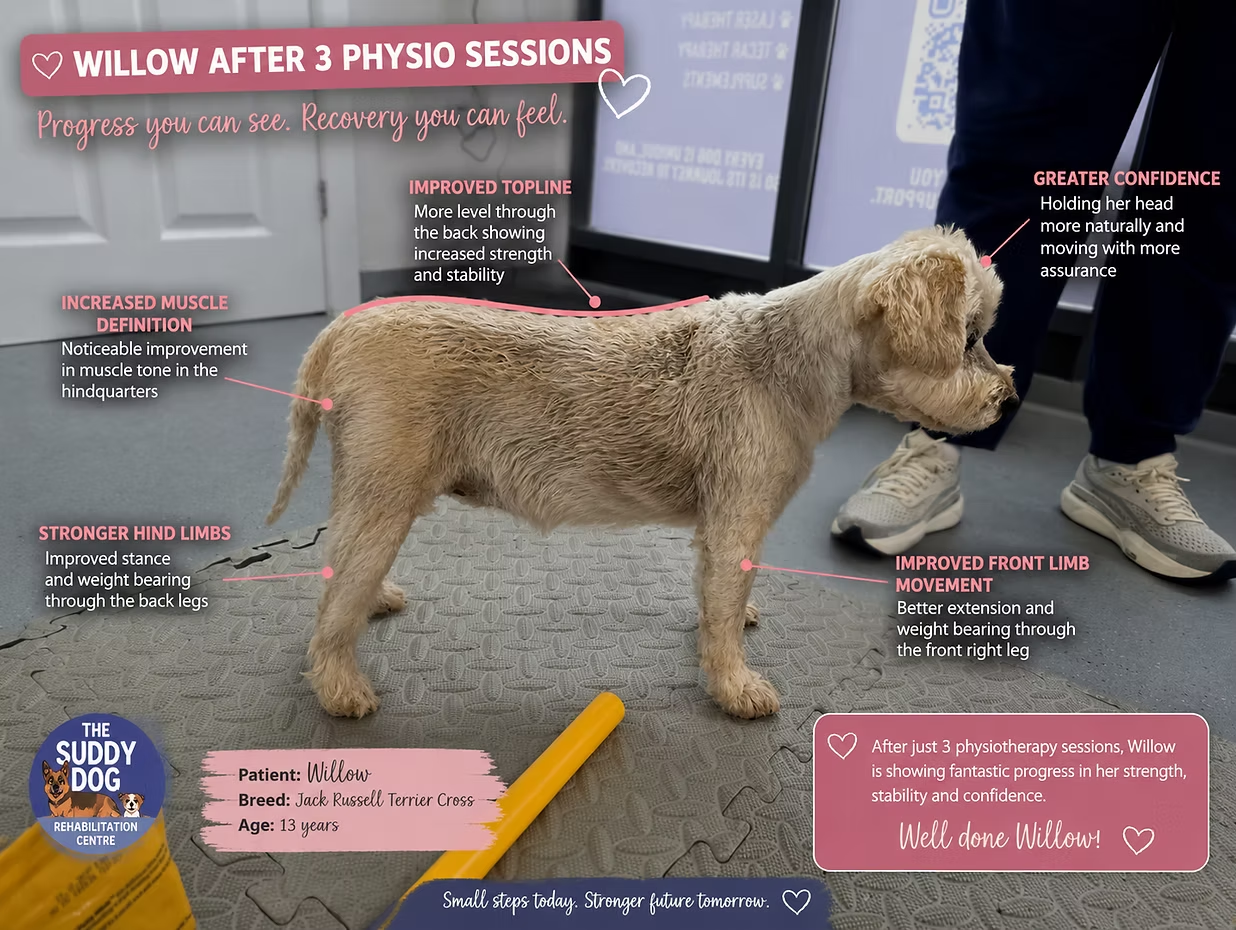
Before hydrotherapy began, physiotherapist Caroline identified a rounded back posture, cervical muscle atrophy, increased muscle tension through the back and reduced neck mobility.
The initial hydrotherapy assessment also identified:
- Reduced extension of the right forelimb.
- Reduced muscle tone in both hindlimbs.
- A mild right hindlimb tremor.
- Hip laxity, particularly on the right.
These findings shaped a programme focused on supported movement, paw placement and gradual progression.
Why combine physiotherapy and underwater treadmill exercise?
Initial physiotherapy included laser therapy, gentle manual therapy and controlled neck mobility exercises.
The hydrotherapy programme consisted of weekly underwater treadmill sessions, with reassessment after six sessions. A relatively high water level provided buoyant support while Willow practised walking.
This setting allowed the team to assist limb movement and paw placement while observing each step. Early sessions required substantial hands-on help with the hindlimbs. Particular attention was paid to outward rotation of the left hindlimb during its forward movement.
The treatment aimed to encourage active hindlimb use, improve awareness of paw position and develop pelvic stability and confidence. Progression depended on Willow’s movement quality and tolerance of exercise.
Session 6: greater independence in movement
At reassessment on 9 August 2026, Willow was independently advancing both hindlimbs in the treadmill, with more appropriate paw placement and substantially reduced hindlimb tremors.
She could also walk into the centre, having previously needed to be carried.
Treadmill exercise had progressed to a brisk walking pace with a 2-degree incline, while the high water level was maintained to provide support.
Forelimb movement remained a treatment priority. Willow still took short, quick steps and occasionally tripped, so gentle manual assistance was sometimes needed to encourage more controlled forward movement.
Her progress was meaningful, but rehabilitation was still ongoing.
Tendiboots™: making changes in gait easier to follow
The initial Tendiboots™ walking assessment, performed on 23 May 2026, provided baseline measurements of loading, stride height, stride length and timing. Repeating the assessment at Session 6 added a side-by-side comparison of all four limbs to the team’s observations of Willow’s growing independence.
More symmetrical hindlimb strides
The clearest changes concerned hindlimb stride length and height.
The calculated difference in stride length between the hindlimbs decreased from approximately 40% to 10.5%, a reduction of around 29.5 percentage points. Recorded stride heights also became equal.
| Hindlimb measure | Baseline left | Baseline right | Session 6 left | Session 6 right |
|---|---|---|---|---|
| Peak GRF (N/kg) | 15.4 | 16.0 | 15.8 | 17.5 |
| Stride height (cm) | 5 | 4 | 3 | 3 |
| Stride length (cm) | 8 | 12 | 9 | 10 |
| Stance time (ms) | 602 | 547 | 299 | 288 |
Peak GRF is peak ground reaction force normalised to body mass, a measure of gait loading rather than muscle strength. Stride-length percentages use the absolute left–right difference divided by the mean of both sides, multiplied by 100, based on the rounded case-report values.
The hindlimb recordings showed more similar stride lengths and equal stride heights at reassessment. Although stride height decreased on both sides, the clearer finding was the closer match between limbs. These measurements added detail to the progress observed during Willow’s rehabilitation.
Peak loading increased on both hindlimbs, particularly on the right, while the left–right difference also increased. Tracking stride and loading measures together gave the team a more complete picture of Willow’s changing gait and the differences to follow at future assessments.
Forelimb measurements: completing the picture
| Forelimb measure | Baseline left | Baseline right | Session 6 left | Session 6 right |
|---|---|---|---|---|
| Peak GRF (N/kg) | 17.3 | 32.9* | 15.1 | 18.4 |
| Stride height (cm) | 3 | 6 | 3 | 4 |
| Stride length (cm) | 9 | 12 | 10 | 12 |
| Stance time (ms) | 467 | 385 | 257 | 307 |
*Recording note: the baseline right forelimb value requires caution because fewer strides were captured and the high loading value had no matching visual finding; it cannot reliably establish a change in loading. The baseline assessment was indoors and the repeat outdoors. Differences in recording conditions and walking speed may affect comparisons, particularly stance time.
The forelimb recordings complemented the hindlimb comparison, documenting stride length, height and loading on each side. Read alongside the short, quick steps and occasional tripping observed during sessions, they formed part of the record for continued follow-up.
Together, the measurements and clinical observations made it possible to follow both Willow’s growing independence and the movement patterns that still needed attention.
Why continued physiotherapy remained important
A subsequent physiotherapy note, recorded in September, documented ongoing difficulties despite Willow’s earlier progress.
Her owner reported hindlimb tremors during feeding, when Willow tended to stretch her hindlimbs behind her rather than maintain a square stance. Assessment also identified an altered walking pattern, reduced active limb flexion and muscular sensitivity.
Her rounded back posture nevertheless remained improved compared with the initial physiotherapy assessments.
Treatment included light-based therapy, massage and gentle stretching within tolerance, alongside continuation of the demonstrated home exercises.
This later review helped keep rehabilitation focused on Willow’s everyday needs, including her stance during feeding, limb movement and comfort.
How Tendiboots™ supported follow-up
For Steven and the rehabilitation team, Tendiboots™ added a numerical record to their observations: a baseline to revisit, side-by-side limb comparisons and measurements to follow as Willow’s rehabilitation progressed.
Combined with clinical assessment, the results helped the team:
- Document changes in hindlimb stride symmetry and timing.
- Identify residual differences requiring follow-up.
- Interpret progress alongside independence, coordination and exercise tolerance.
- Communicate findings to Willow’s veterinary team.
The combined findings supported a further block of six underwater treadmill sessions, with continued work on hindlimb strength, balance, paw placement and forelimb movement quality.
The next stage of Willow’s recovery
The next planned milestone is a review after twelve sessions, including repeat clinical assessment and Tendiboots™ walking analysis.
The team will reassess independent limb movement, forelimb stride quality, pelvic stability and tremors, including those observed during feeding. Repeat measurements under similar conditions will help assess whether the improvements have been maintained.
Willow’s case illustrates how functional milestones and objective measurements can inform each other. Walking into the centre and advancing her hindlimbs independently were important achievements; ongoing assessment helps the team understand what support she still needs.
About Steven Graham and The Suddy Dog Rehabilitation Centre
Steven Graham is a small animal hydrotherapist and co-owner of The Suddy Dog Rehabilitation Centre, based in Banbridge, Northern Ireland.
The centre brings together hydrotherapy, veterinary physiotherapy, gait analysis and other rehabilitation services to support dogs with mobility difficulties. In Willow’s case, this combined approach allowed the team to follow both her progress during treatment and the challenges she continued to experience at home.