Ekico's scientific research
These studies focus on Tendiboots™ Canine, our sensor-based locomotion analysis system.
For the wider veterinary literature behind each gait parameter (34 scientific references), see our clinical metrics guide.
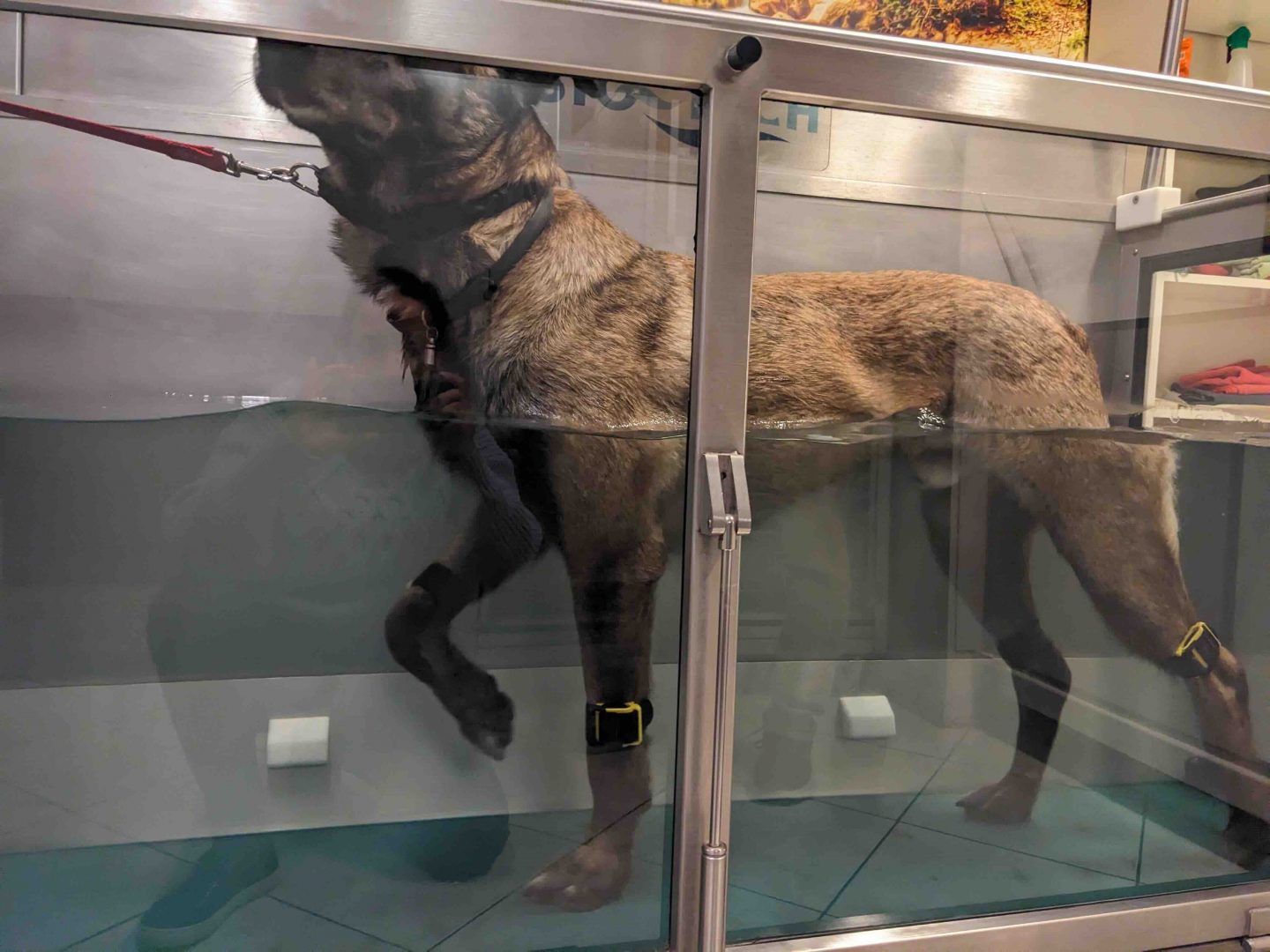
Canine gait on an underwater treadmill at fixed settings
We analysed five sessions from three dogs. Belt speed, incline and water level stayed constant within each of the seven walking segments. Four minutes after the first usable measurement in each segment, the index of limb angular acceleration during swing was higher in four segments and lower in three. At six minutes, it was below baseline in all five segments with usable data.
Stéphane Juban · ePoster · FASAVA 2026, Taipei
Monitoring shoulder tendinopathy in an agility dog
Rio, a Border Collie with biceps tenosynovitis, underwent monthly assessments during rehabilitation. Gait sensors and ultrasound were used to follow his progress. The examinations showed gradual improvement, and ultrasound at 18 weeks showed that the tenosynovitis had resolved.
Stéphane Juban and Plinio Lidano · Poster · ECVSMR 2025, Turin
Limb asymmetry in dogs at the trot
How much do paired limbs differ at the trot in dogs with no visible lameness? Using a dataset of more than 1,000 dogs across several lameness grades, the study established reference values for grade 0 dogs. These values describe the distribution of differences between paired limbs for an acceleration-derived measure.
Stéphane Juban · ePoster · WSAVA 2025, Rio de Janeiro
Detecting lameness with a neural network
The team used gait recordings annotated by veterinarians to test whether a neural network could identify which side a dog was lame on. In this preliminary study, when the model predicted left-sided lameness with a confidence score above a certain threshold, it was correct more often than not.
Laureline L. Chaise, Damien Sornette, Morgane Gérout-Juban and Stéphane Juban · Poster · ESVOT 2024, Lisbon
Induced lameness and limb asymmetry in one dog
Hemispheres of different diameters were placed under the pads of one dog’s paw to induce different degrees of lameness. The gait sensors recorded greater asymmetry between the forelimbs with the larger hemispheres.
Stéphane Juban · Poster · IAVRPT 2024, Cape Town · Abstract published in VCOT in 2025