
The analysis of canine locomotion is essential for veterinarians to diagnose, treat, and ensure proper rehabilitation of canine locomotor disorders.
What are the different aspects of canine locomotion analysis? What are the complementarities between static and dynamic data?
Postural analysis of the dog in a static position
Static analysis focuses on assessing the dog when it is standing still. This allows for the detection of postural abnormalities and uneven weight distribution. Compensation patterns can then be identified, where the animal adjusts its posture to relieve a painful area or a limb with functional impairment (muscle weakness, joint stiffness, etc.).

Tools like the Stance Analyzer (Companion Animal Health) allow for visualizing and evaluating weight distribution and abnormal postural patterns in a stationary animal.
Typical postural patterns of pathologies may be adopted.
For example, in cases of anterior cruciate ligament rupture: weight shift to the contralateral hind limb as well as the diagonal forelimb.
Sometimes, the animal may retain a compensatory postural pattern out of habit or apprehension even after the pathology has been treated and pain is no longer present.
These compensatory patterns are at the core of detecting locomotion asymmetries in dogs – an essential skill for identifying and interpreting them during consultation.
Dynamic analysis of dog locomotion
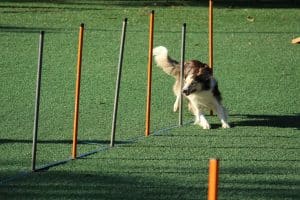
Unlike static analysis, dynamic analysis focuses on examining the dog in motion.
The Tendiboots™ Canine tool stands out by providing precise data on the dog’s dynamic locomotion.
This analysis is crucial for identifying pain and abnormalities that may not be detectable when the animal is stationary.
Indeed, some pain is generated by movement and may not be visible when the animal is in a static position. This is especially true for tendon and muscle injuries.
Similarly, some load-bearing pain is amplified during locomotion.

Monitoring the dog during rehabilitation: Improvement in gait vs weight distribution in static position
When a dog is undergoing rehabilitation, it is crucial to monitor both its improvement in movement and the distribution of its weight in a static position.
A dog may show visible improvement in gait but continue to display uneven weight distribution when stationary. This is common and is due to the poor posture habits the animal developed while it was in pain. Even with visible improvement in dynamic locomotion, the dog may tend to maintain a poor postural pattern at rest, simply out of habit.
Conversely, a dog might show correct weight distribution in a static position but exhibit gait abnormalities when walking and/or trotting. This is less common but possible, such as in cases of pathologies causing pain when a joint is mobilized. In such cases, the dog is pain-free when not moving but shows visible pain during movement.

“At the clinic, we are equipped with the Stance Analyzer and Tendiboots™.
Whenever possible, I try to use both tools in my rehabilitation treatments.
In the vast majority of cases, I have observed a correlation between static and dynamic analysis.
And when monitoring a dog in rehabilitation, I often see a significant improvement in gait earlier than what is observed statically.
Indeed, we know that correcting compensations often takes longer in a static position. This is true for dogs, but it’s also a common phenomenon for humans: for example, after a knee surgery, it takes several months to achieve symmetrical weight distribution between both legs while standing still.
Tendiboots™ Canine and the Stance Analyzer prove to be complementary tools in monitoring dogs in rehabilitation.”
- Static data (weight distribution across the 4 limbs)
- Identification of load-bearing pain
- Detection of support defects due to functional impairment (joint stiffness, muscle weakness)
- Characterization of compensatory postural patterns
- Not suitable for animals that do not remain calmly stationary
- Dynamic data (impact forces, stride lengths, stride phase times)
- Highlights load-bearing pain
- Reveals pain related to movement (myotendinous system function or joint mobilization)
- Identifies lameness due to functional impairment (joint stiffness, muscle weakness)
- Characterizes compensatory motor patterns
- Not compatible with animals that do not walk calmly, and animals that do not tolerate being touched (for the placement of sensors)
For a deeper look at how this data is applied in a clinical setting, see our article on locomotion data in canine physiotherapy.
Want to know more about Tendiboots™ Canine?
FAQ
Static assessment identifies chronic weight-shifting patterns and postural compensations adopted through habit or pain avoidance. Dynamic gait analysis reveals true kinematic abnormalities during active weight-bearing. Both are clinically indispensable: together they distinguish resting pathology from movement-induced pain affecting the musculotendinous system or joint mobilisation. Neither assessment alone gives a complete clinical picture.
The motor system tends to adapt faster to resumed movement than to deeply ingrained postural reflexes acquired during the painful phase. A dog may return to a symmetrical trot while still offloading a limb during quiet standing — purely by habit. This is well-recognised in human orthopaedic rehabilitation: restoring symmetrical static weight-bearing often takes considerably longer than restoring functional gait. Monitoring both parameters prevents premature discharge
Tendon and muscle pathologies, as well as conditions involving painful joint mobilisation, are frequently pain-free at rest but functionally limiting in motion. A patient may show normal weight distribution during stance while displaying measurable gait asymmetries — reduced peak vertical forces, altered stance phase durations, shortened stride lengths. These are precisely the presentations that static assessment alone fails to detect.
Combining objective static and dynamic data transforms subjective visual impressions into a trackable, evidence-based record. Session-by-session comparison reports — showing changes in weight distribution and gait parameters — provide referring veterinary surgeons with clear, reproducible findings and support client compliance with home exercise programmes. This positions the rehabilitation practitioner as a rigorous clinical partner.
The patient must walk or trot calmly in a controlled environment. Wearable sensor systems additionally require a patient that tolerates application of the device to all four limbs. Excitable or contact-averse patients may not be suitable candidates initially. In these cases, static assessment provides a useful first step before progressing to full dynamic evaluation.
This is one of the most clinically challenging questions in canine rehabilitation. Static gait analysis helps identify persistent weight-shifting that should have resolved with tissue healing, while dynamic analysis reveals whether gait asymmetries correlate with active mechanical pain or are purely neuromotor habits. Comparing both datasets across successive sessions — particularly in post-orthopaedic cases — allows the clinician to determine whether to escalate investigation or focus on motor retraining.
Visual assessment is essential but carries well-documented limitations: inter-observer agreement is poor for subtle lameness, and bilateral compensations are frequently missed because they appear symmetrical. Research indicates that even experienced clinicians may miss up to 30% of the asymmetries captured by objective sensor systems. Instrumented gait analysis does not replace clinical judgement — it augments it by quantifying what the eye cannot reliably measure and providing a reproducible, auditable record.