Long used in human medicine, canine hydrotherapy, also called aquatic therapy for dogs, is gradually making its way into veterinary medicine for the same therapeutic benefits. Walking in water has, however, been practised for several centuries, particularly with horses..
Aquatic rehabilitation can therefore be useful in a variety of situations and for different species (dogs, cats, horses, etc.). Far beyond a simple soak in a pool, hydrotherapy requires a veterinary assessment before creating a plan with specific exercises and an appropriate number of sessions. Veterinarians practising this discipline are known as rehabilitation veterinarians.
What is hydrotherapy and what are its benefits?
As its name suggests, hydrotherapy is a therapy that uses the various properties of water. It is one of many physiotherapy techniques, a discipline recognized by the Veterinary Association*.
The properties of water help reduce the weight the body normally has to support on land, thanks to Archimedes’ principle and buoyancy in animal rehabilitation, reducing body weight support by approximately 60–70%. Being lighter, the mechanical stress applied by normal body weight is reduced, relieving the animal. In addition, the hydrostatic pressure exerted by water on the immersed parts of the body provides well-documented benefits for inflammation control and also helps reduce pain.
At water level set at the greater trochanter, buoyancy reduces vertical ground reaction forces by approximately 62%, substantially decreasing joint loading while still allowing active muscle engagement. This unloading effect is particularly relevant in post-operative patients or dogs with severe joint pain who cannot tolerate full weight-bearing on land (Levine et al., 2010). Research further confirms that water level significantly impacts joint kinematics, with higher water levels required to influence more proximal joints , a clinically relevant finding when designing individualised UWTM protocols (Bliss et al., 2022).
To learn more about physiotherapy in veterinary medicine: Veterinary physiotherapy.
Canine hydrotherapy offers multiple benefits. First and foremost, it helps reduce an animal’s pain. Various exercises are recommended for joint issues such as osteoarthritis, or for muscular weaknesses — including muscle atrophy prevention in senior dogs. Aquatic exercise also supports increased range of motion (ROM), drives proprioception improvement via aquatic exercise, and builds low-impact cardiovascular fitness for canines. It is therefore beneficial for sporting dogs, whether for conditioning or recovery after exertion. Finally, hydrotherapy promotes circulation and has a gentle “massaging” effect.
For which conditions can hydrotherapy be used?
Aquatic rehabilitation can be useful in a wide range of situations, whether for preventive or therapeutic purposes. It can be used alone or alongside other treatments, depending on the indication. In a therapeutic context, such as after surgery, the goal is recovery and rehabilitation. Here are a few non-exhaustive examples:
- In aging animals: particularly in cases of osteoarthritis or locomotor pain, but also for the circulation benefits provided by hydrotherapy;
- To restore locomotion following musculoskeletal disorders: post-surgery after a fracture, dislocation, dysplasia, cruciate ligament rupture, or tendinitis;
- In overweight or obese animals: hydrotherapy allows them to exercise, helping to lose weight while simultaneously building muscle mass;
- In sporting animals: for preparation for physical activity (endurance, muscle conditioning) and/or for recovery after exercise;
- For disc herniation (IVDD);
- In cases of muscular disorders;
- In cases of neurological disorders (e.g. Wobbler syndrome, post-IVDD rehabilitation);
- Etc.
To learn more about hydrotherapy in dogs : Canine hydrotherapy.
Caution: although canine hydrotherapy has many benefits, it is contraindicated in certain cases; epileptic animals, active skin conditions or open wounds, severe cardiovascular compromise, and uncontrolled infectious disease. Furthermore, hydrotherapy is not suitable for all musculoskeletal disorders. Only a veterinarian’s case-by-case evaluation of the benefit–risk balance can determine whether this therapy is appropriate for a particular animal. A prior veterinary assessment is therefore essential. Hydrotherapy is also contraindicated for animals that are afraid of water, particularly some cats
To learn more about canine locomotion in hydrotherapy: Canine locomotion analysis in hydrotherapy
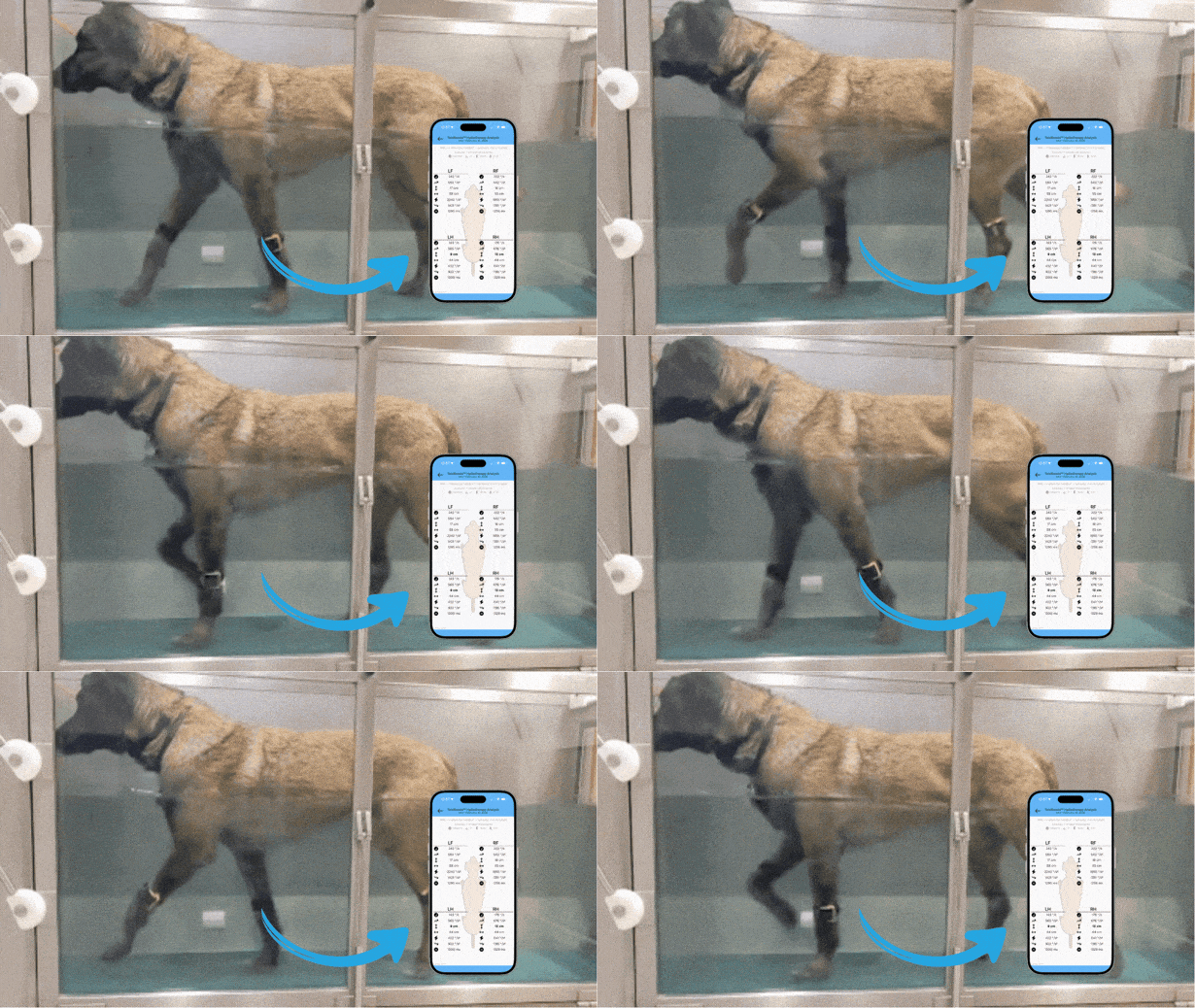
One of the key advances in canine aquatic rehabilitation is the ability to objectively monitor locomotion during UWTM sessions. With a waterproof system such as Tendiboots™ Canine (Hydro option), practitioners can collect real-time gait data – symmetry index, stride parameters, ground reaction forces – directly on the underwater treadmill. This turns each session into a measurable intervention, enabling evidence-based protocol adjustments and clear progress reporting to referring veterinarians.
Which Hydro features to read at each water setting is explained in our underwater treadmill metrics guide.
NEW : Use your Tendiboots™ on an underwater treadmill
What are the differences and complementarities between an underwater treadmill (UWTM) and a water pool?
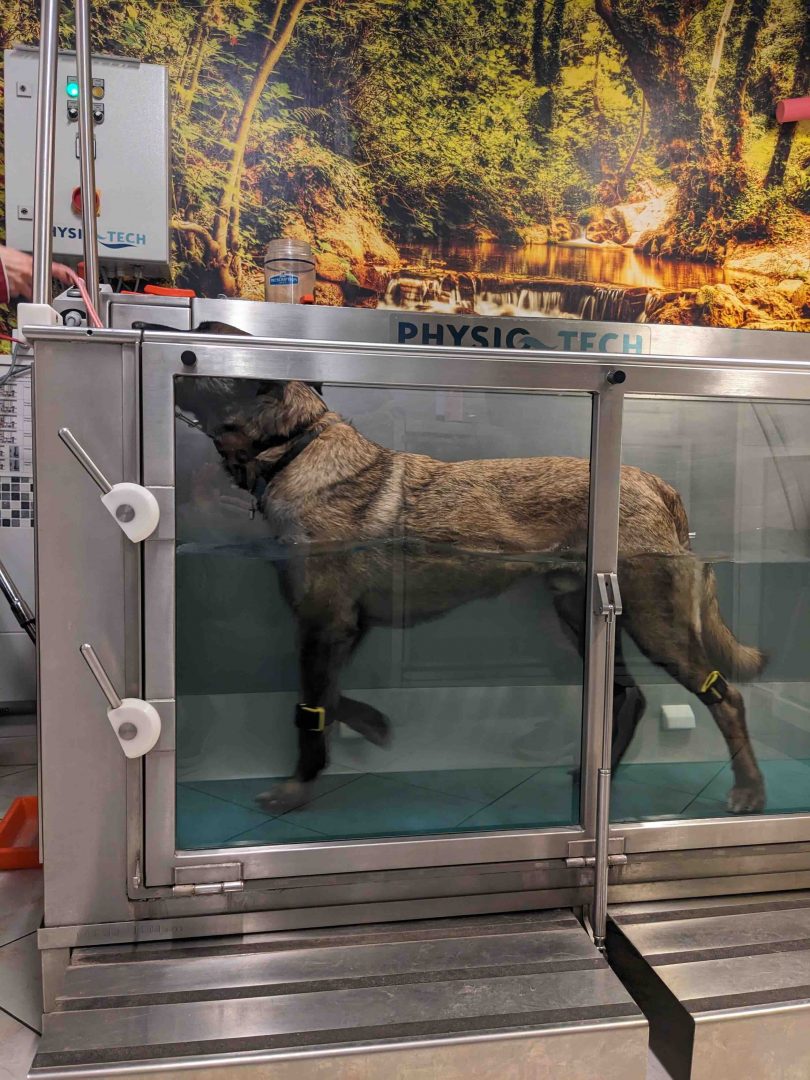
Hydrotherapy can be performed in a large water pool (or swimming pool) or in a smaller pool containing an underwater treadmill (UWTM), often referred to as a hydrotherapy tub or table. Various parameters can be adjusted depending on the animal and the situation, including water temperature (hot or cold), water level at different stages, treadmill incline, speed, and more. In addition, accessories such as vests, weights, or different water jets can be added as needed, based on the exercises prescribed by the veterinarian and to ensure the animal’s safety.
A session can last between 5 and 30 minutes, and the number of sessions is determined by the veterinarian. The choice between a UWTM and a water pool depends on the exercises prescribed and the specific needs of the animal. Several techniques are used in hydrotherapy, including manual massage or massage with water jets, mobilization exercises, walking, swimming, or adjusting water temperature according to the desired effect (for example, muscle relaxation with warm water). Sometimes, even the environment can vary (such as swimming in the sea). The exercises and movements are never forced and should not cause discomfort to the animal. All equipment requires space and knowledge for proper use, as devices vary between models.
One of the advantages of the underwater treadmill is that multiple parameters can be precisely adjusted, such as speed or water level. The higher the water level, the less weight the body must support, which can be beneficial for specific joints or targeted body areas. In sporting animals, these parameters can be tailored to the individual and their training to optimize performance and build endurance. Additionally, temperature adjustments are important depending on the species (dog, cat, or horse), as each has a different ideal temperature. Owners are often invited to participate in sessions to monitor progress and encourage their animal.
* Training is essential to practice this discipline. One example is the Diploma (DE) in Kinesiology, Physiotherapy, and Functional Rehabilitation offered by the Alfort National Veterinary School
FAQ
Aquatic therapy is indicated for orthopaedic conditions (hip dysplasia, patellar luxation, CCL rupture), neurological rehabilitation (IVDD, Wobbler syndrome), post-operative recovery, chronic osteoarthritis management, and athletic conditioning in sporting dogs. A veterinary assessment is required before initiating any protocol.
Water at the greater trochanter level provides approximately 60–70% body weight support while maintaining sufficient resistance for muscle activation. Lower water levels increase joint loading (strengthening goal); higher levels maximise buoyancy (acute or neurological patients). Level must be adjusted per patient and therapeutic goal.
Yes. With a waterproof system such as Tendiboots™ Canine (Hydro option), veterinarians and physiotherapists can collect quantitative locomotion data directly on the underwater treadmill, enabling real-time monitoring of rehabilitation progress.
Absolute contraindications include epilepsy, skin conditions or open wounds, severe cardiovascular compromise, and uncontrolled infectious disease. Relative contraindications require case-by-case veterinary evaluation. A formal veterinary referral is mandatory before initiating any programme.
A standard UWTM programme typically consists of 20-minute sessions, twice weekly over 5 consecutive weeks. Initial sessions for post-operative patients may begin at 5–10 minutes, with progressive increases based on the patient’s response.
Sources
- French Association of Veterinarians in Physiotherapy and Functional Rehabilitation (Afvephyr)
- Technical file: Practice of Veterinary Physiotherapy and Functional Rehabilitation (PDF)
- Lorenza Richard. Hydrotherapy devices are still relatively rare in France. La Semaine Vétérinaire, no. 1408, 04/06/2010.
- Levine D. et al. (2010). Effects of partial immersion in water on vertical ground reaction forces and weight distribution in dogs. American Journal of Veterinary Research.
- Bliss S. et al. (2022). Water level effects on joint kinematics in canine underwater treadmill exercise.