Long used in human medicine, this discipline is gradually making its way into veterinary medicine for the same benefits. However, walking in water has already been practiced for several centuries, particularly with horses.
Hydrotherapy can therefore be useful in a variety of situations and for different species (dogs, cats, horses, etc.). Far beyond a simple soak in a pool, hydrotherapy requires a veterinary assessment before creating a plan with specific exercises and an appropriate number of sessions. Veterinarians practicing this discipline are known as rehabilitation veterinarians.
What is hydrotherapy and what are its benefits?
As its name suggests, hydrotherapy is a therapy that uses the various properties of water. It is one of many physiotherapy techniques, a discipline recognized by the Veterinary Association*.
The properties of water help reduce the weight the body normally has to support on land, thanks to Archimedes’ principle and buoyancy. Being lighter, the stress applied by normal body weight is reduced, relieving the animal. In addition, the pressure exerted by water on the immersed parts of the body also helps reduce pain.
To learn more about physiotherapy in veterinary medicine: https://ekico.fr/en/blog/tendiboots-canine-en/veterinary-physiotherapy/
Hydrotherapy offers multiple benefits. First and foremost, it helps reduce an animal’s pain. Various exercises are also recommended for joint issues, such as osteoarthritis, or for muscular weaknesses. It improves endurance and can therefore be beneficial for sporting animals, whether for preparation or recovery after exertion. Finally, hydrotherapy also promotes circulation and has a gentle “massaging” effect.
For which conditions can hydrotherapy be used?
Hydrotherapy can be useful in a wide range of situations, whether for preventive or therapeutic purposes. It can be used alone or alongside other treatments, depending on the indication. In a therapeutic context, such as after surgery, the goal is recovery and rehabilitation. Here are a few non-exhaustive examples:
- In aging animals: particularly in cases of osteoarthritis or locomotor pain, but also for the circulation benefits provided by hydrotherapy;
- To restore locomotion following musculoskeletal disorders: post-surgery after a fracture, dislocation, dysplasia, cruciate ligament rupture, or tendinitis;
- In overweight or obese animals: hydrotherapy allows them to exercise, helping to lose weight while simultaneously building muscle mass;
- In sporting animals: for preparation for physical activity (endurance, muscle conditioning) and/or for recovery after exercise;
- For disc herniation;
- In cases of muscular disorders;
- In cases of neurological disorders;
- Etc.
To learn more about hydrotherapy in dogs
: https://ekico.fr/en/blog/tendiboots-canine-en/canine-hydrotherapy/
Caution: although hydrotherapy has many benefits, it is also contraindicated in certain cases, such as in epileptic animals, with certain skin conditions, or in animals with significant cardiovascular issues. Furthermore, hydrotherapy is not suitable for all musculoskeletal disorders. Only a veterinarian’s case-by-case evaluation of the benefit-risk balance can determine whether this therapy is appropriate for a particular animal. For this reason, a prior assessment is essential.
In addition, hydrotherapy is also contraindicated for animals that are afraid of water, particularly some cats.
To learn more about canine locomotion in hydrotherapy : https://ekico.fr/blog/tendiboots-canine/analyse-de-la-locomotion-du-chien-en-hydrotherapie/
NEW : Use your Tendiboots™ on an underwater treadmill
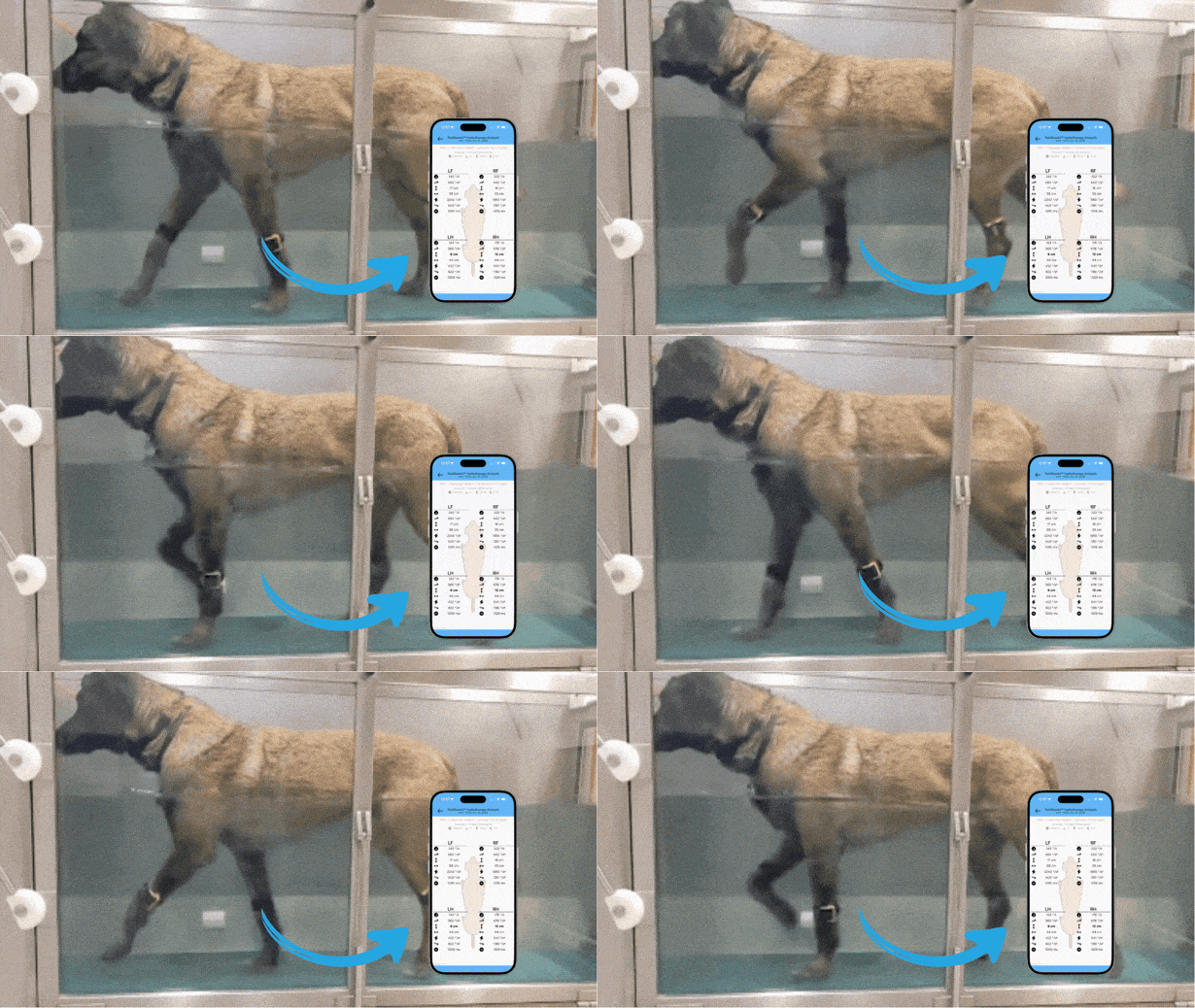
What are the differences and complementarities between an underwater treadmill and a water pool?
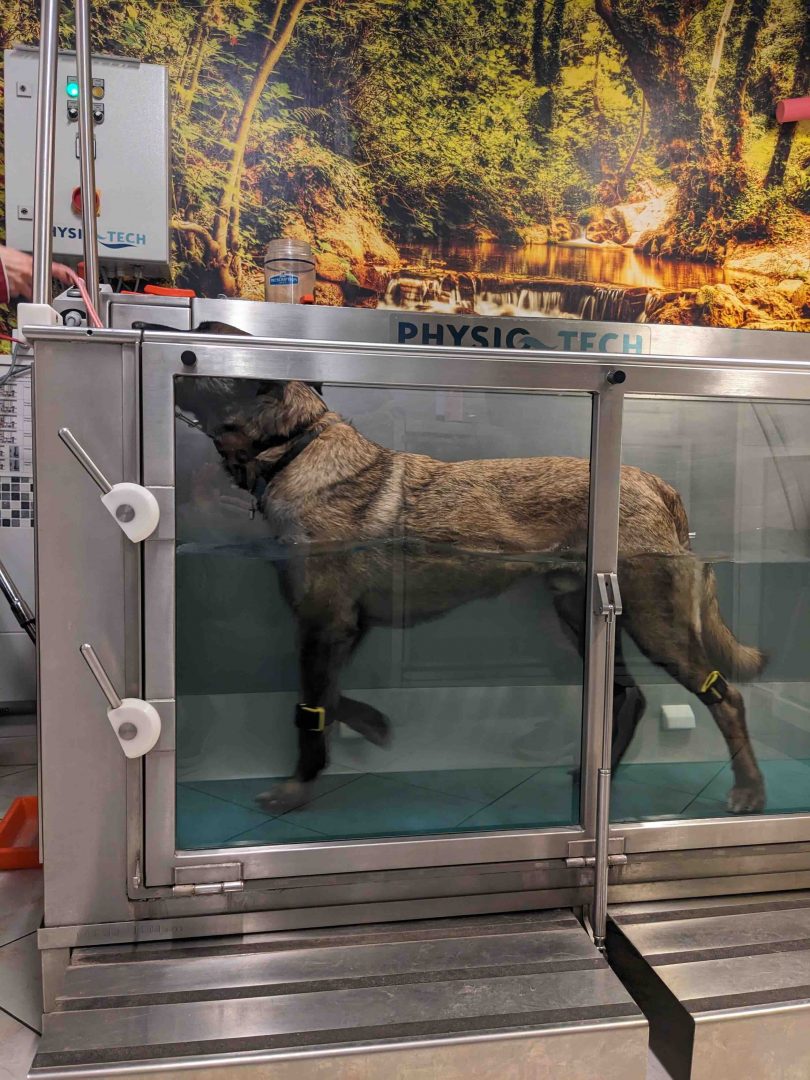
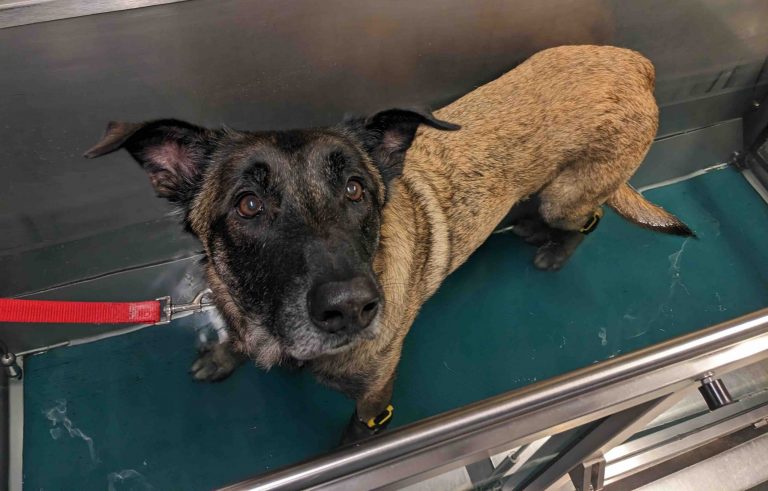
Hydrotherapy can be performed in a large water pool (or swimming pool) or in a smaller pool containing an underwater treadmill, often referred to as a hydrotherapy tub or table. Various parameters can be adjusted depending on the animal and the situation, including water temperature (hot or cold), water level at different stages, treadmill incline, speed, and more. In addition, accessories such as vests, weights, or different water jets can be added as needed, based on the exercises prescribed by the veterinarian and to ensure the animal’s safety.
A session can last between 5 and 30 minutes, and the number of sessions is determined by the veterinarian. The choice between an underwater treadmill and a water pool depends on the exercises prescribed and the specific needs of the animal. Several techniques are used in hydrotherapy, including manual massage or massage with water jets, mobilization exercises, walking, swimming, or adjusting water temperature according to the desired effect (for example, muscle relaxation with warm water). Sometimes, even the environment can vary (such as swimming in the sea). The exercises and movements are never forced and should not cause discomfort to the animal. All equipment requires space and knowledge for proper use, as devices vary between models.
One of the advantages of the underwater treadmill is that multiple parameters can be precisely adjusted, such as speed or water level. The higher the water level, the less weight the body must support, which can be beneficial for specific joints or targeted body areas. In sporting animals, these parameters can be tailored to the individual and their training to optimize performance and build endurance. Additionally, temperature adjustments are important depending on the species (dog, cat, or horse), as each has a different ideal temperature. Owners are often invited to participate in sessions to monitor progress and encourage their animal.
* Training is essential to practice this discipline. One example is the Diploma (DE) in Kinesiology, Physiotherapy, and Functional Rehabilitation offered by the Alfort National Veterinary School: https://alforpro.vet-alfort.fr/course/view.php?id=179§ion=1
Sources :
- French Association of Veterinarians in Physiotherapy and Functional Rehabilitation (Afvephyr) : https://www.afvephyr.fr/
- Technical file: Practice of Veterinary Physiotherapy and Functional Rehabilitation. Available at : https://www.veterinaire.fr/system/files/files/2021-11/physiotherapie_actes_et_delegations_02072015.pdf
- Lorenza Richard. Hydrotherapy devices are still relatively rare in France. La Semaine Vétérinaire, no. 1408 04/06/2010.